Desire Hydraulics is a GDC Machine Manufacturer designing and building Gravity Die Casting Machines in-house at MIDC Bhosari, Pune — including Tilting, Stationary, Alloy Wheel, Vertical, Horizontal and Special Customized GDC Machines — sized to your clamping force, platen and daylight requirement, and pressure-tested before dispatch to foundries across India and the UAE.
Actual tilting and stationary GDC machines engineered, assembled and tested at our MIDC Bhosari facility — click any photo to view it larger.
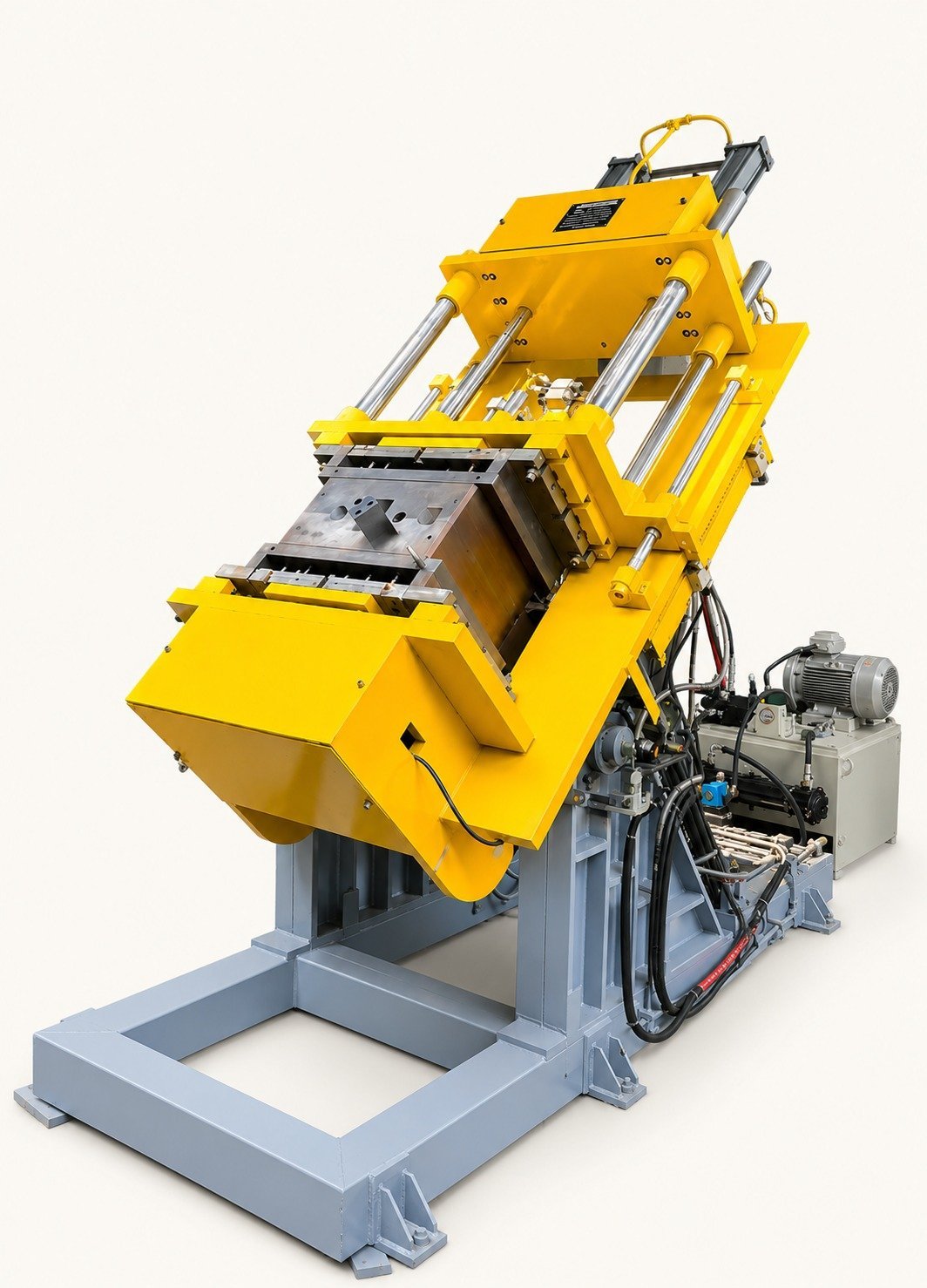
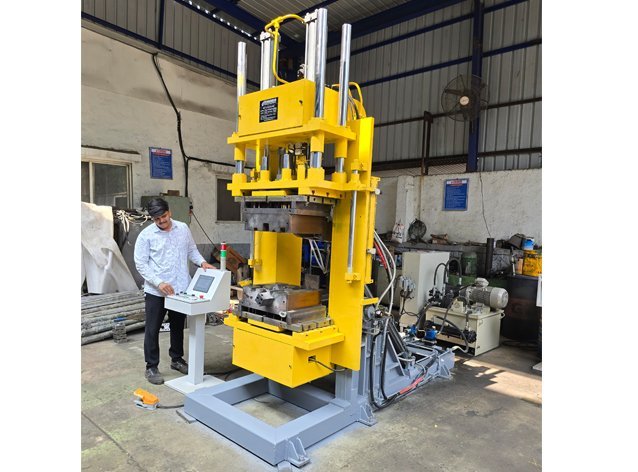
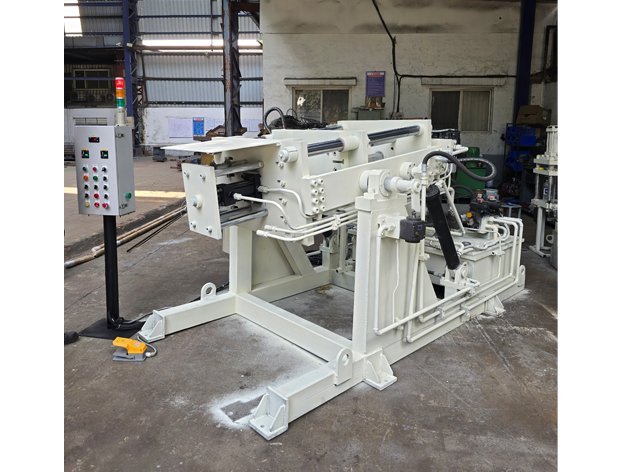
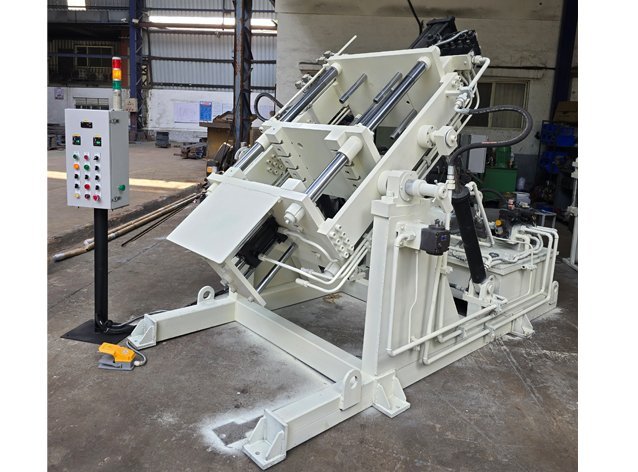
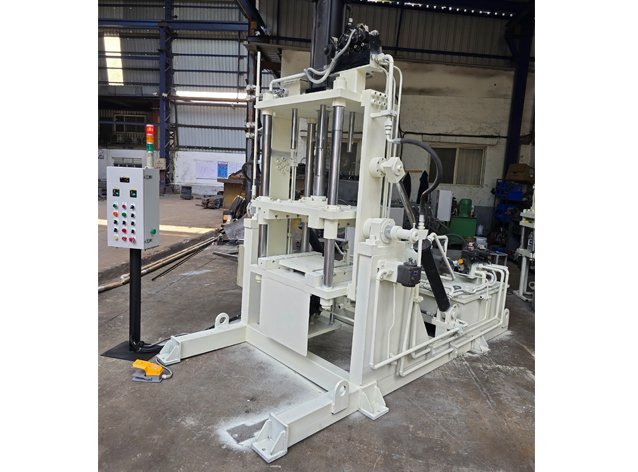
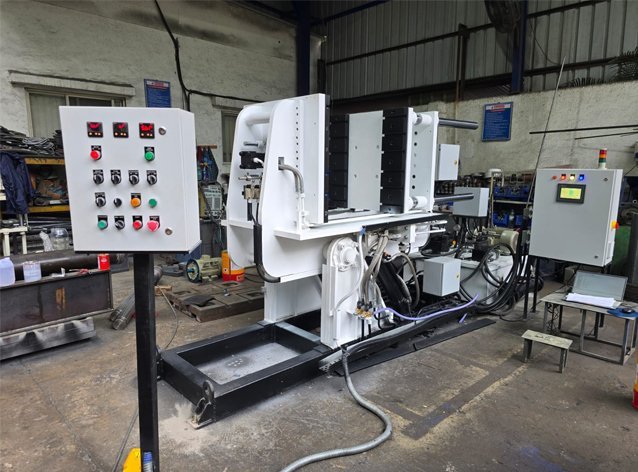
A Gravity Die Casting (GDC) Machine uses gravity — rather than injected pressure — to fill a reusable metal die with molten non-ferrous metal, most commonly aluminium. Desire Hydraulics manufactures tilting-type GDC machines in Pune, Maharashtra, where the die tilts through a controlled arc during pouring so the metal fills the cavity smoothly, reducing turbulence, porosity and rejection rates compared to static pouring.
Every machine is engineered around a hydraulic clamping unit that holds the two die halves shut under load during solidification, and a tilt-drive assembly that governs the pour angle and speed. Because both are built in-house, we can size the clamping force, platen width, daylight opening and tilt angle to the actual part being cast, rather than fitting your job around a fixed catalogue frame.
Frames, cylinders, tilt gearboxes and control panels are fabricated, assembled and pressure-tested on our own floor at MIDC Bhosari before a machine is cleared for dispatch — the same in-house approach behind the 5,000+ hydraulic machines we've delivered across India and the UAE.
A GDC Machine, also known as a Gravity Die Casting Machine, is equipment used to produce cast components using a reusable metal mould or die. Unlike high-pressure die casting, where molten metal is forced into a die at high injection pressure, gravity die casting relies mainly on controlled pouring and gravity to fill the mould cavity.
The die is normally manufactured from suitable tool steel or other appropriate die materials and consists of mould sections that create the required shape of the casting. Depending on the component, the die may also incorporate cores, slides, cooling passages, runners, gates, vents and an ejection arrangement.
The basic objective of a GDC machine is to provide controlled and repeatable movement of the die, controlled pouring and filling conditions, suitable cooling or solidification conditions, and safe removal of the finished casting. Modern casting equipment can incorporate hydraulic systems, mechanical mechanisms, sensors, controls, temperature monitoring, automated die movement and other auxiliary systems to improve consistency and productivity.
The Gravity Die Casting process follows a sequence of controlled operations. The exact cycle depends on machine design, component, alloy and die configuration, but the underlying principle stays the same.
The reusable metal die is cleaned and prepared, with a suitable coating or release treatment applied depending on the alloy and process requirements before it is positioned for the next cycle.
The mould sections are brought into the required closed position, with alignment and clamping maintained so the die stays properly closed during filling and solidification.
The selected alloy — typically aluminium or another suitable non-ferrous alloy — is melted separately and brought to the required pouring temperature and condition.
Molten metal is introduced through the designed pouring system, with gravity carrying it through the sprue, runners and gates into the mould cavity while the gating and venting control the fill.
Once the cavity is filled, the metal cools and solidifies against the die surfaces. Cooling channels in the die help control heat removal and support consistent, defect-free solidification.
After sufficient solidification, the die opens and the casting is removed — manually, mechanically, hydraulically or via automation — before it proceeds to trimming, machining, inspection or finishing.
A Gravity Die Casting Machine brings together mechanical, hydraulic, electrical and control systems. The exact configuration depends on the machine type and the customer's requirement.
The die itself is one of the most important parts of the complete casting system. A properly designed die must provide suitable metal flow, venting, cooling, ejection and dimensional control.
Standard on every unit, and adjusted to your part before fabrication begins.
Motorised tilt drive governs pour angle and speed for a smooth, low-turbulence fill.
Sized clamping cylinder holds die halves shut under solidification pressure without drift.
Platen width and die-opening daylight built to your tooling, not a fixed frame size.
Guarded tilt zone and clamp interlocks to keep the operator clear during the pour cycle.
Straightforward electricals for tilt, clamp and cycle control — PLC control on request.
Every clamping cylinder and tilt drive is run and checked under load before it leaves our floor.
Every machine is engineered to the part being cast — these ranges reflect what we commonly build; exact figures are confirmed against your drawing.
| Machine type | Tilting-type Gravity Die Casting (GDC) Machine |
|---|---|
| Clamping force | Custom-built to part and die weight, as per requirement |
| Platen width | Sized to your die tooling |
| Daylight (die opening) | Sized to your die height and ejection stroke |
| Tilt angle | Up to approx. 95°, motor-driven |
| Clamping type | Hydraulic cylinder clamping |
| Control | Panel-mounted controls; PLC/semi-automatic control available on request |
| Construction | Fabricated steel frame, in-house machining and assembly |
| Testing | Pressure-tested under load before dispatch |
Looking for an exact clamping force, platen size or tilt profile? Share your die drawing and part weight and we'll size the machine against it.
Different castings require different machine configurations. The right configuration depends on component design, die arrangement, alloy, casting method, production volume, automation requirement and the desired method of filling and solidification.
Tilts or rotates the die during the casting cycle so controlled die movement — instead of a fixed pouring position — creates a more controlled filling sequence.
Uses a fixed die position while molten metal is poured through the designed pouring and gating arrangement — a straightforward operating cycle where the die doesn't need to rotate or tilt.
A specialized configuration built around the geometry, metal distribution, solidification and dimensional accuracy that alloy wheel casting demands.
Uses a vertical die arrangement, with die movement, pouring and ejection configured around vertical operation — useful where component geometry benefits from it.
Uses a horizontal die arrangement and mould movement, which can suit certain component geometries and offer convenient access depending on layout.
Built around the product, die, production cycle, automation system or factory layout when a standard configuration can't efficiently handle the application.
Gravity Die Casting Machines are used for manufacturing a variety of metal components. Applications depend on the alloy, component geometry, die design, production requirements and casting specifications.
Selected automotive components and aluminium castings where permanent-mould casting is appropriate.
Industrial machinery and engineering applications needing repeatable geometry and material properties.
Suitable cast components for electrical, industrial and equipment manufacturing applications.
Housings, covers and bodies produced using permanent-mould casting, depending on design and alloy.
Specialized GDC equipment configured for alloy wheel manufacturing applications.
Various aluminium castings compatible with gravity die casting's design and production requirements.
Gravity Die Casting offers several potential advantages when the process is correctly matched to the component.
Unlike sand moulds made for individual casting cycles, GDC uses reusable dies suited to repeated production.
A properly maintained permanent die gives repeatable dimensions across multiple production cycles.
Metal dies provide a relatively smooth mould surface, improving surface quality over expendable moulding.
Useful wherever manufacturers require repeated production of the same or similar component.
Tilting, stationary, vertical, horizontal, alloy wheel and customized configurations adapt to your process.
Several operations can be mechanized or automated, improving cycle consistency and cutting operator intervention.
Selecting the correct Gravity Die Casting Machine starts with understanding the product before selecting the equipment.
Clamping force, platen and daylight sized to your actual tooling and part.
Frame fabrication, machining, assembly and testing all done at MIDC Bhosari.
Clamping cylinders and tilt drives are run under load before the machine ships.
Installation guidance and after-sales service across India and the UAE.
Common questions we hear from foundries evaluating a Gravity Die Casting machine.